
CMAX Trading: One Store, Four Categories — Toys, Perfume, Ornaments & Mobile Accessories on a Custom Shopify Expanse Build
Client: CMAX Trading | Market: Qatar | Website: cmaxtrading.com | Project: Shopify Store Customization | Status: Live & Scaling
About CMAX Trading
CMAX Trading is a Qatar-based multi-category retailer selling toys, perfume, ornaments and mobile accessories. Rather than running separate storefronts for each product line, the client wanted a single trusted destination — similar in spirit to established multi-category retail sites in the region — where a customer could land on the homepage and move between completely different departments without it ever feeling like four different shops stitched together.
Challenge: Turn one Shopify theme into a store that can credibly sell fast-moving toys, premium perfume, delicate ornaments and everyday mobile accessories side by side — with room to add a fifth category (flowers) later without rebuilding the navigation, theme structure or catalog logic.
The Business Challenge: Four Categories, One Coherent Store
The brief was deceptively simple to describe and hard to execute well: "open the site, click Ornaments, get the ornaments store; click Mobile Accessories, get that store — all inside one website." Doing that properly raised several distinct problems:
- Category-Level Navigation at Scale: Four (soon five) unrelated departments needed their own visual identity inside shared navigation, without the mega menu turning into a cluttered list of links
- Catalog Taxonomy: 243+ products needed consistent Vendor, Collection, Type, Tag and Shopify Category mapping so filtering, search and the mega menu could all read from the same structured data instead of manual curation per category
- Search That Actually Gets Used: The client wanted a persistent, always-visible search bar rather than an icon-triggered overlay — closer to how large regional retail sites are laid out — which the base theme didn't expose as a Theme Editor toggle
- Trust for a Qatar Audience: Delivery, returns and authenticity messaging needed to read as credible for a Gulf retail buyer, not a generic template placeholder
- Arabic-Ready: The store needed to support Arabic-language customers without a separate build
- Room to Grow: The client was explicit that flowers would be added as a fifth category later — the mega menu, collection structure and homepage sections all needed to accommodate that without rework
The core problem: Off-the-shelf multi-category Shopify themes handle one department well by default. CMAX needed the theme's built-in flexibility located, exposed and configured correctly across four departments at once — most of it wasn't missing, it was just hidden behind Theme Editor limitations that needed direct code edits to unlock.
The Solution: Extending Expanse Without Breaking It
We built on the Expanse theme (Maestrooo, v9.1.0) — chosen for its strong multi-category navigation defaults — and extended it through targeted Liquid and CSS edits, metaobject-driven content blocks, and a properly structured catalog, keeping the base theme upgradeable rather than forking it.
Metaobject-Driven Mega Menu with Brand Grids & Banner Tiles
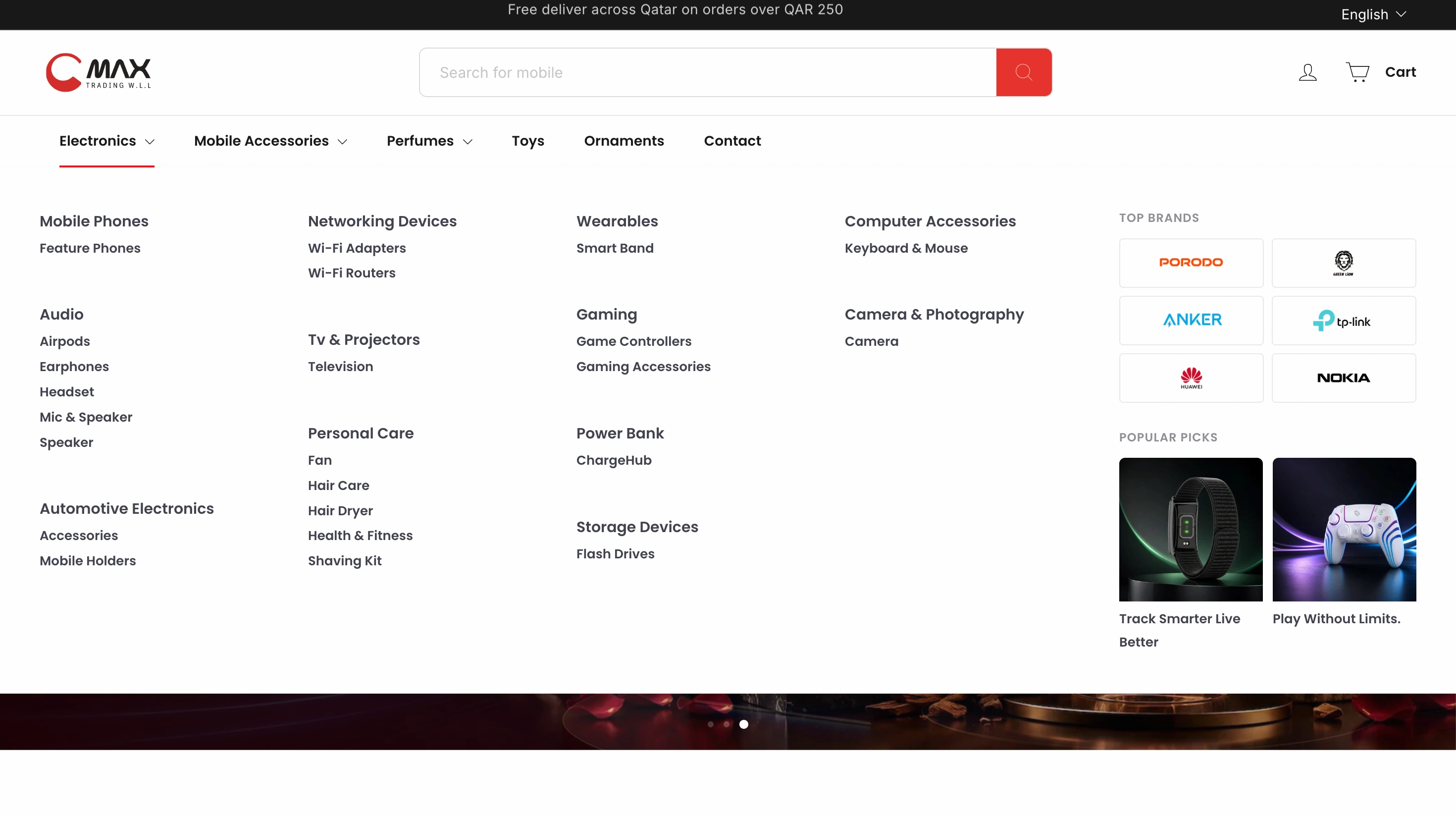
Instead of hardcoding menu content, the mega menu pulls from Shopify metaobjects — so brand logo grids and promotional banner tiles per category can be updated by the client from the admin without touching code. Each of the four categories (Toys, Perfume, Ornaments, Mobile Accessories) gets its own menu section with relevant brand logos and imagery, keeping the navigation scannable instead of one long undifferentiated list.
Impact: Customers land in the right department in one click, and the client can refresh brand/banner content seasonally without a developer.
Persistent Header Search Bar (Custom Liquid Edit)
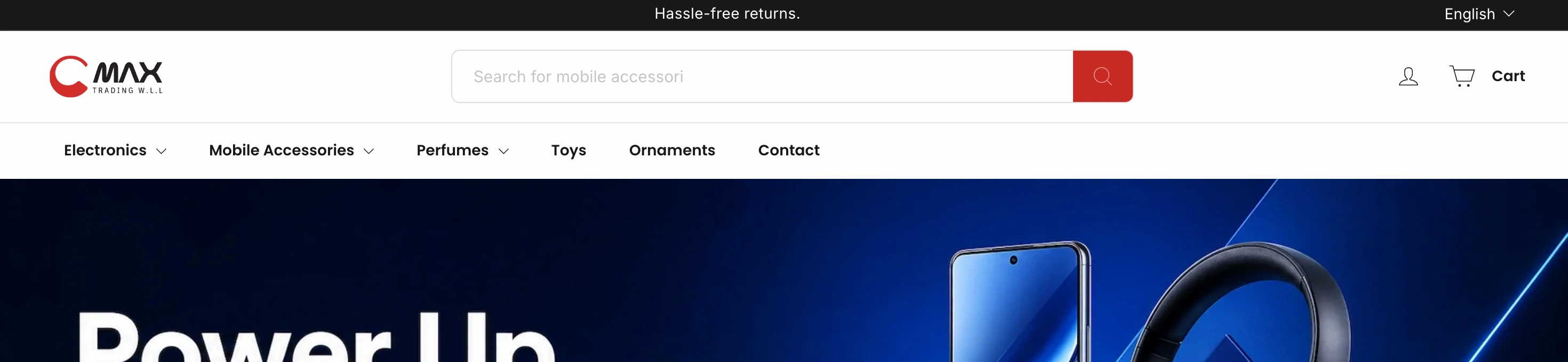
The client wanted a full-width, always-visible search bar between the logo and the Account/Cart icons — not the default icon-triggered overlay. Expanse's predictive search form already existed in the theme but wasn't exposed as a persistent element. We edited snippets/section.header.liquid to render form.predictive-search directly in the header, added scoped CSS to position and size it correctly on desktop, and hid the legacy icon-triggered search markup so only one search bar appears — the exact styling and troubleshooting path (isolating .js-search-header and .site-header__search-container as the leftover elements) took a couple of iterations to get pixel-clean.
Impact: Search is now the first thing a customer sees in the header, matching the reference design the client approved.
Structured Catalog Across 243+ Products
Every product was mapped against Vendor, Collection, Type, Tags and Shopify's standard Category taxonomy. This structured tagging is what powers the mega menu's brand grids, the Shop by Category homepage grid, collection-level filtering, and the Bestsellers section — all reading from the same underlying data instead of being manually curated per section.
Impact: New products slot into the right category, filters and menus automatically once tagged correctly, which matters given four active departments and a fifth (flowers) planned.
Homepage Built for Four (and Soon Five) Departments
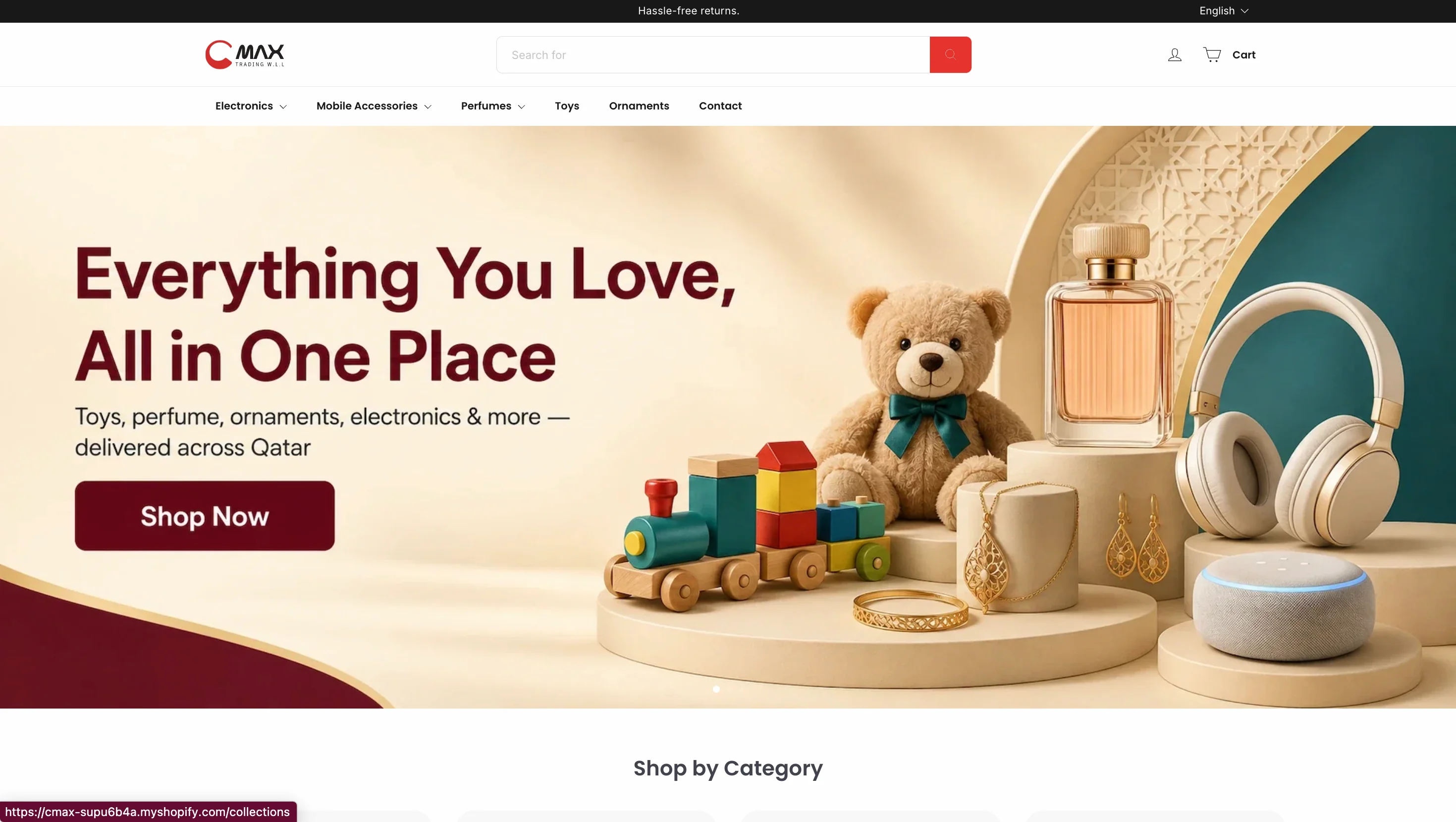
The homepage was structured around: a hero for brand storytelling, a trust/value-prop row (delivery, returns, authenticity), a "Shop by Brand" logo list linking into vendor-filtered collections, a "Shop by Category" grid driven by the four core collections, a Bestsellers section pulling from tagged top-sellers, and an announcement bar with countdown support for flash sales. Every section was designed to read cleanly with four categories today and to absorb a fifth without a layout redesign.
Trust Messaging for a Qatar Retail Audience
Generic placeholder trust copy was replaced with Qatar-specific messaging — nationwide delivery terms, a clear returns window, cash-on-delivery availability and authenticity guarantees — positioned as a "Why Choose Us" section so a first-time visitor gets a fast trust signal before browsing four unfamiliar categories at once.
Localization, Reviews & Store Polish
Beyond the core build, the store shipped with: Arabic language support for Gulf customers, Judge.me review integration for social proof, collection badge logos and subcollection tiles for richer category pages, custom buy-button styling to match the brand, and mobile navigation fixes so the four-category menu structure works cleanly on small screens.
Category & Collection Structure
The store is organized around five collection handles designed for the mega menu, homepage Shop by Category grid, and navigation to read from automatically:
- Toys — fast-moving, high-frequency purchase category
- Perfume — premium positioning, brand-led discovery
- Ornaments — visually led category, benefits from banner tiles
- Mobile Accessories — highest SKU count, benefits most from filtering and vendor tags
- Bestsellers — cross-category, tag-driven social proof section
- Flowers (planned) — structure left in place so this can be added as a fifth department without touching navigation or homepage sections
Technical Implementation: Non-Destructive Theme Customization
- Theme Choice: Expanse (Maestrooo, v9.1.0) — a premium, multi-category-first Shopify theme with strong mega menu defaults
- Metaobjects: Brand logos and banner tiles stored as Shopify metaobjects, editable from admin without code
- Liquid Templating: Direct edits to header and search snippets to expose built-in but hidden theme functionality
- Scoped CSS: Header search bar positioning, legacy element hiding, and responsive behavior handled through theme-scoped stylesheets
- Catalog Taxonomy: Vendor / Collection / Type / Tags / Shopify Category mapped consistently across 243+ products
- Third-Party Apps: Judge.me for reviews, layered into the existing product page without disrupting theme performance
- Localization: Arabic language support configured alongside the default English storefront
Key Learnings from a Multi-Category Build
- Premium themes hide more than they show: Both the persistent search bar and other layout requests turned out to be functionality already built into Expanse — just not surfaced as a Theme Editor toggle. Reading the theme's own snippets before reaching for a rebuild saved significant time
- Taxonomy first, design second: Getting Vendor/Collection/Type/Tag mapping right across the catalog is what let the mega menu, homepage sections and filters all stay in sync without manual curation
- Design for the category you don't have yet: Structuring collections and navigation to absorb a planned fifth category (flowers) up front avoids a navigation rebuild later
- One trust section carries a lot of weight: For a multi-category store where trust in one department (e.g. perfume authenticity) needs to transfer to another (e.g. mobile accessories), a single strong "Why Choose Us" section does more work than category-specific trust copy
Planning a multi-category or multi-brand Shopify store?
If you're bringing several product lines together under one storefront — or need a premium Shopify theme's hidden functionality actually unlocked rather than rebuilt from scratch — we specialize in exactly this kind of strategic theme customization.
Book Your Shopify Customization Strategy Call