
Key Takeaways
- WhatsApp is the primary way most Kerala customers expect to contact a business — automation here has more impact than on most other channels.
- Good WhatsApp automation handles the repetitive 80% (FAQs, booking confirmations, order status) so a real person can focus on the 20% that actually needs a human.
- The most common failure isn't bad technology — it's bots that never hand off to a human, which frustrates customers more than no automation at all.
- Setup typically takes 1-3 weeks depending on complexity, not months, and starts paying for itself the moment it stops a business from losing leads to slow replies.
If you run a business in Kerala, chances are more customers message you on WhatsApp than call you or fill out a contact form. That's not a guess — it's just how communication works here now. Which is exactly why WhatsApp automation matters more for Kerala businesses than it does in a lot of other markets.
This guide covers what WhatsApp automation actually does, what it doesn't do well, and how to think about whether your business needs it.
What WhatsApp Business Automation Actually Is
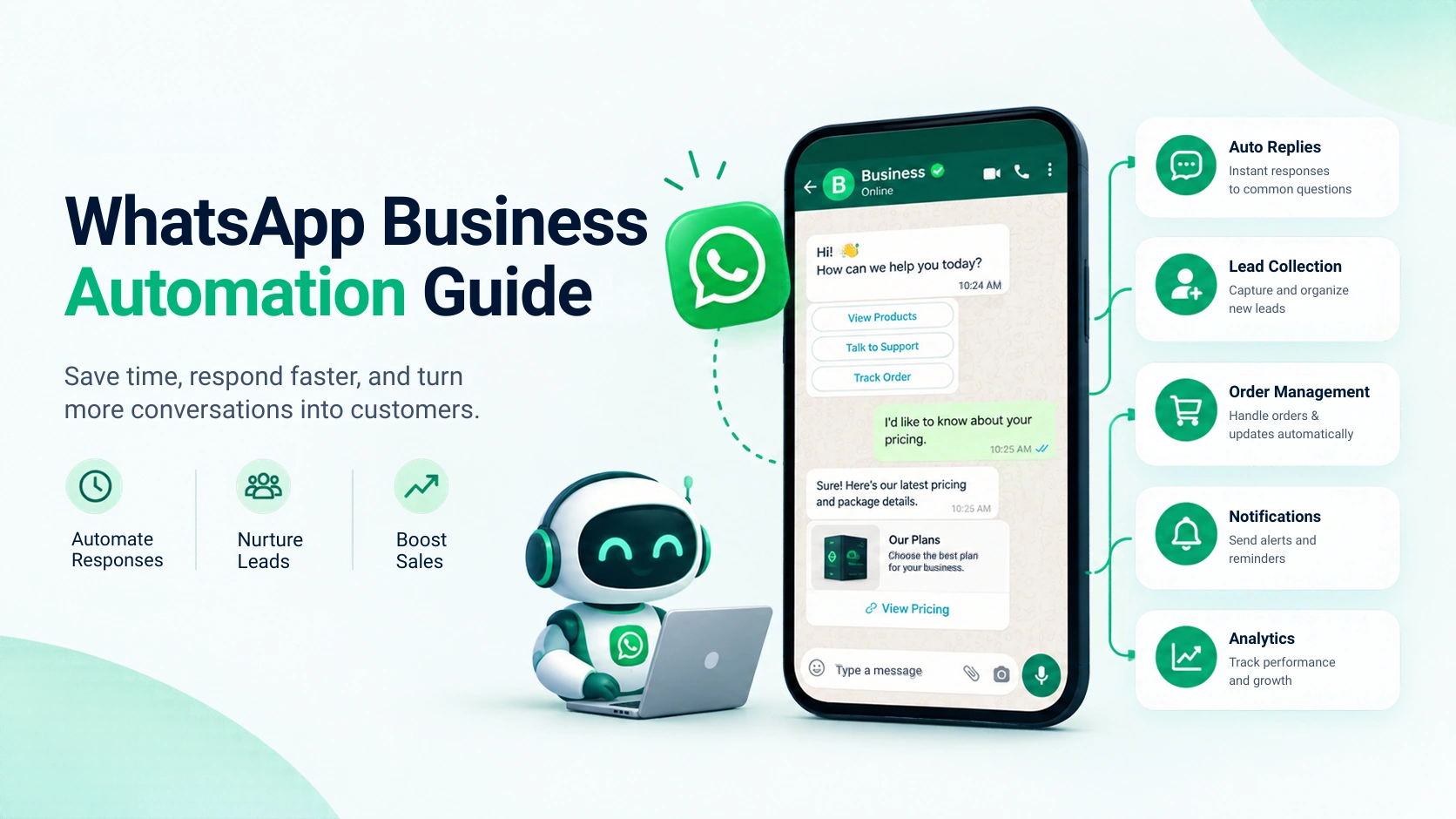
At its core, WhatsApp automation means setting up automatic responses, workflows, and integrations on your business WhatsApp number — so common customer interactions get handled instantly, without someone manually typing a reply every time.
This isn't just an "away message." A properly built system can:
- Answer common questions instantly (hours, pricing, location, availability)
- Qualify a lead by asking a few quick questions before routing it to a person
- Send booking confirmations, order updates, and delivery status automatically
- Capture a customer's details and push them straight into a CRM or spreadsheet
- Hand off to a real person the moment a conversation needs actual judgment
Why This Matters More for Kerala Businesses Specifically
A few things make this particularly relevant here:
- WhatsApp is the default channel. Most customers reach out here first, before a phone call or a website contact form.
- Response speed decides the sale. If a customer messages three shops asking the same question, the one that replies first often wins the business — regardless of price.
- After-hours and weekend gaps are common. A shop closed at 9pm still gets messages at 9pm. Automation means those don't just sit unanswered until morning.
What Automation Should Not Try to Do
This is the part most guides skip, and it's the part that actually matters most. The single biggest reason WhatsApp automation fails isn't bad technology — it's bots that trap customers in a loop with no way to reach a real person.
A good system knows its limits. It should:
- Recognize when a question is too complex or sensitive for an automated reply
- Always offer a clear path to a human, not force the customer to keep guessing menu options
- Never pretend to be a person when it isn't — customers notice, and it damages trust faster than a slow reply would have
The goal isn't to remove people from the conversation. It's to let automation handle the repetitive, predictable 80% of messages, so the people on your team can spend their time on the 20% that actually needs a human — the price negotiation, the custom order, the customer who's upset about something.
What a Real Setup Looks Like
A working WhatsApp automation system for a small or mid-size business typically includes:
- Instant FAQ responses — for the questions you get asked every single day
- Lead qualification flow — a few quick questions before a lead reaches your sales team, so nobody wastes time on unqualified inquiries
- CRM or spreadsheet integration — every conversation and lead logged automatically, nothing lost in someone's personal phone
- Booking and order confirmations — sent the moment an action happens, no manual follow-up needed
- A clean human handoff — one tap or one message away, always
Setup for a system like this usually takes one to three weeks depending on how many workflows you need and how it needs to connect to your existing tools (CRM, Google Sheets, booking systems, and so on).
Real Results From Kerala Businesses
To make this concrete, here's what this looks like in practice — two systems I've built and run for real clients:
Geethas, an organic turmeric and wellness brand, was spending 4-5 hours a day on manual WhatsApp customer service, with response times of 10-30 minutes. After automating their sales conversations with a multilingual AI bot (Malayalam, Tamil, Hindi, and English), response time dropped to under a second, order processing time fell from 45-60 minutes to 5-10 minutes, and the owner's daily time on customer service dropped by roughly 85%. Order capacity grew from 15-20 orders a day to over 100, without hiring additional staff. Full details in the Geethas WhatsApp AI automation case study.
For a restaurant client sending daily promotional messages to 1,000+ past guests, the challenge was different: how to send 2,000+ messages a day without triggering Meta's spam detection or getting the account blocked. Using conservative rate limiting, idempotency checks, and full audit logging, the system now runs at a 99.2% delivery rate with zero account blocks and zero duplicate sends across 6+ months of daily operation. See the full breakdown in the WhatsApp bulk messaging case study.
Quick Answers (FAQ)
Does WhatsApp automation replace customer service staff?
No. It handles repetitive, predictable messages so staff can focus on conversations that actually need human judgment, rather than replacing people entirely.
How long does WhatsApp automation take to set up?
Typically one to three weeks, depending on how many workflows are needed and how deeply it needs to integrate with existing tools like a CRM or booking system.
Will customers know they're talking to a bot?
A well-built system is upfront about it when it matters, and always offers a clear, fast way to reach a real person. Trying to disguise a bot as a human usually backfires once a customer realizes it.
Is WhatsApp automation expensive for a small business?
Costs scale with complexity. A basic FAQ and lead-capture setup is affordable for most small businesses, while advanced CRM integrations and multi-step workflows cost more. It usually pays for itself by preventing lost leads from slow replies.
Want WhatsApp Automation Built for Your Business?
See AI Automation Services in Kerala and find out what a working setup would look like for you.

Written by Ajmal
Sharing practical tips on SEO, automation, and digital growth.