Key Takeaways
- SEO stands for Search Engine Optimization — the practice of improving a website to rank higher in search results without paying for ads.
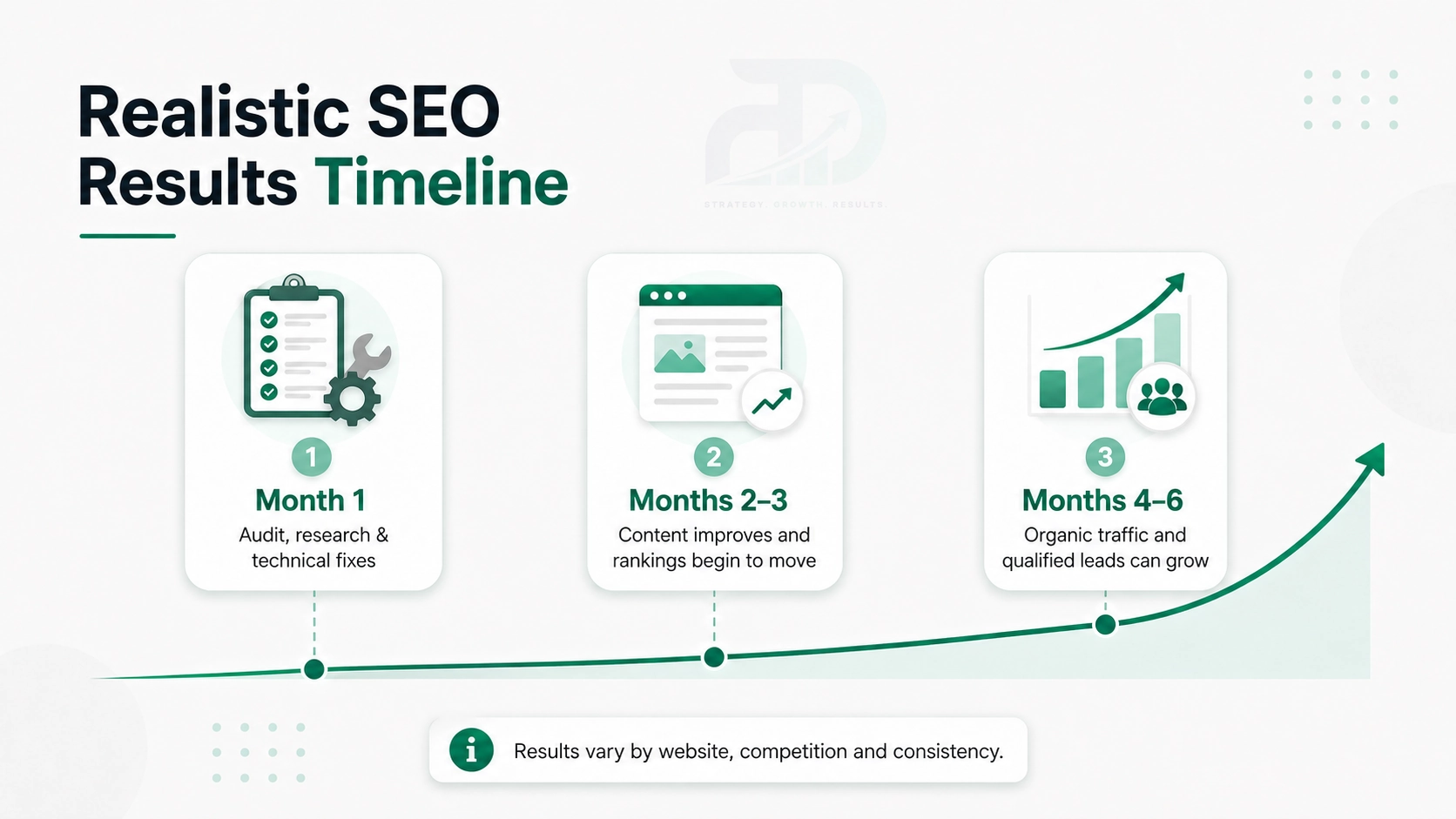
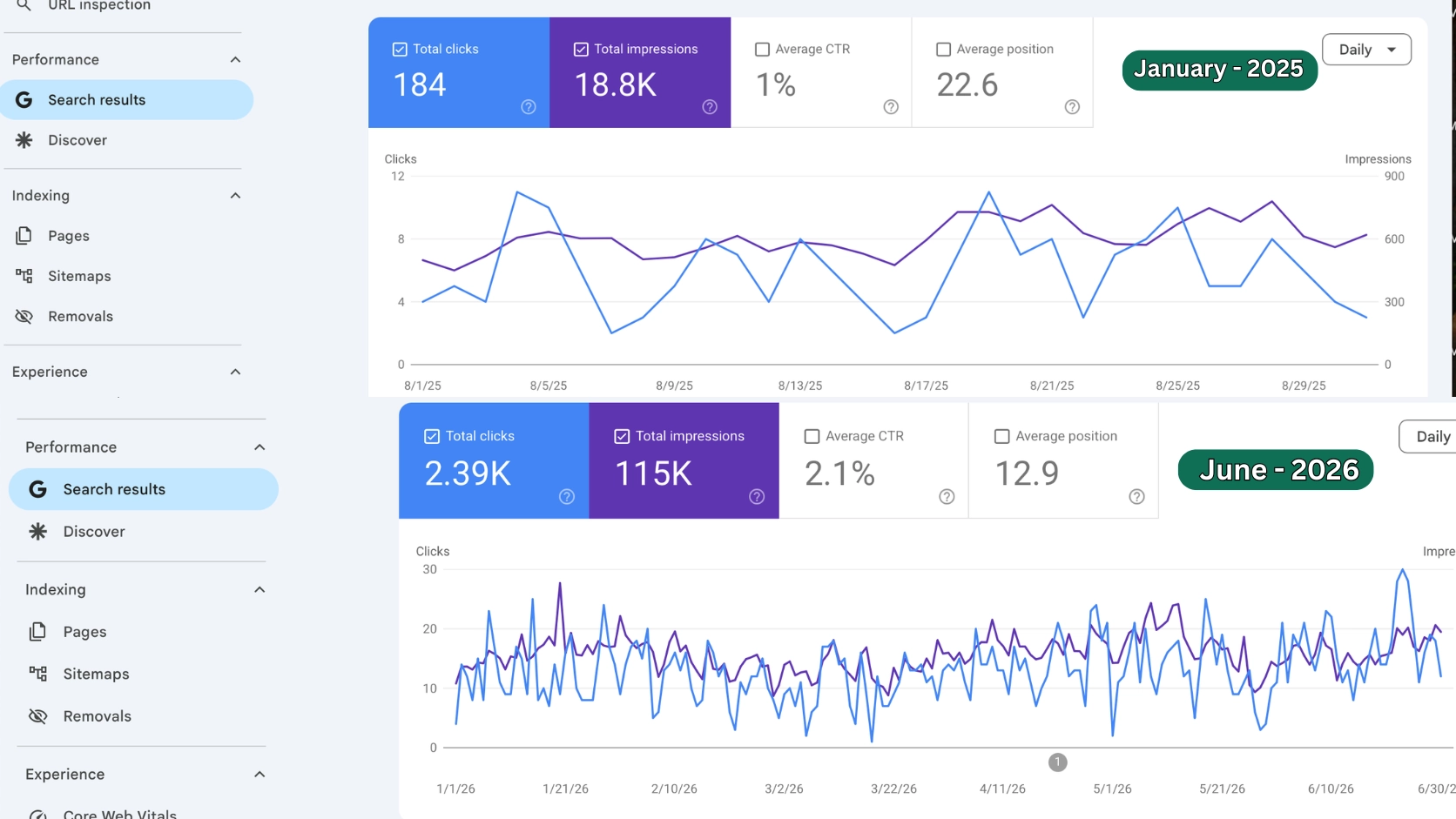
- Real SEO results typically take 3-6 months to show up meaningfully; anyone promising page-one rankings in two weeks is misleading you.
- SEO works in three stages: crawling (Google discovers your pages), indexing (Google analyzes and stores them), and ranking (Google ranks them based on relevance and authority).
- Organic search remains one of the highest-ROI marketing channels available, and AI-powered search still relies on well-optimized content as its source material.
If you've ever searched Google for something and wondered why certain websites show up first — that's SEO at work.
Curious what this could mean for your own business? See our full breakdown of SEO services in Kerala.
SEO stands for Search Engine Optimization — the practice of improving a website so it ranks higher in search results, without paying for ads.
Here's a simple example. Say you sell plastic bottles online. If your SEO is done well, when someone in Kochi or Chennai types "plastic bottles" into Google, your product page shows up on page one — not because you paid for it, but because Google's algorithm decided your page was the most relevant, trustworthy answer to that search. That's organic ranking, and it's the entire point of SEO.
SEO isn't one single task. It's a mix of technical fixes, content strategy, and reputation-building that includes keyword research, fixing site issues, earning backlinks, and continuously improving how a website performs — all aimed at one outcome: showing up when your customers are searching.
What Does SEO Stand For?
SEO stands for Search Engine Optimization — the ongoing process of improving a website's content, structure, and authority so it ranks higher on search engines like Google and Bing.
In simple words, SEO means making a website easy for both search engines and real people to understand, trust, and want to click on. It combines three things:
- Technical improvements — making sure the site is fast, crawlable, and error-free
- Content quality — writing pages that actually answer what people are searching for
- Authority and trust — earning the kind of reputation (through backlinks, reviews, and consistency) that tells Google "this site knows what it's talking about"
There are also two very different approaches to SEO worth knowing early on. White hat SEO follows search engine guidelines and builds results that last. Black hat SEO tries to manipulate rankings through shortcuts — and it usually ends in a penalty that undoes months of work. Every strategy in this guide, and everything we do for our clients, is white hat.
What Is an SEO Website? Why Cheap SEO Doesn't Work
If your website isn't converting and you're thinking about "doing SEO," here's something worth hearing first.
Most business owners go looking for a cheap website and a cheap SEO package. If you actually want to grow a brand, that combination rarely works — because a website with no strategy behind it isn't a website that makes anyone money, no matter how much content gets added to it.
What you need instead is a website built around a strategy: clean, fast, and designed to sell — not just exist. That's the foundation SEO gets built on top of. Skip this step, and no amount of SEO work will fix it.
It's also worth setting expectations early: real SEO results typically take three to six months to show up in a meaningful way. This isn't a guess — it's a benchmark widely cited by SEO research firms like Backlinko and Ahrefs, and it's consistent with what we see across client accounts. Anyone promising page-one rankings in two weeks is selling something other than SEO.
And to be clear about what SEO actually isn't: it's not stuffing a website with hundreds of pages of content, and it's not buying thousands of backlinks. Even something as small as a meta title or meta description only helps when it's built around the right strategy, the right keywords, and the right search intent. Content that only exists to fill a search results snippet — without answering a real question — doesn't move the needle. Quality and relevance beat quantity, every time.
How Does SEO Actually Work?
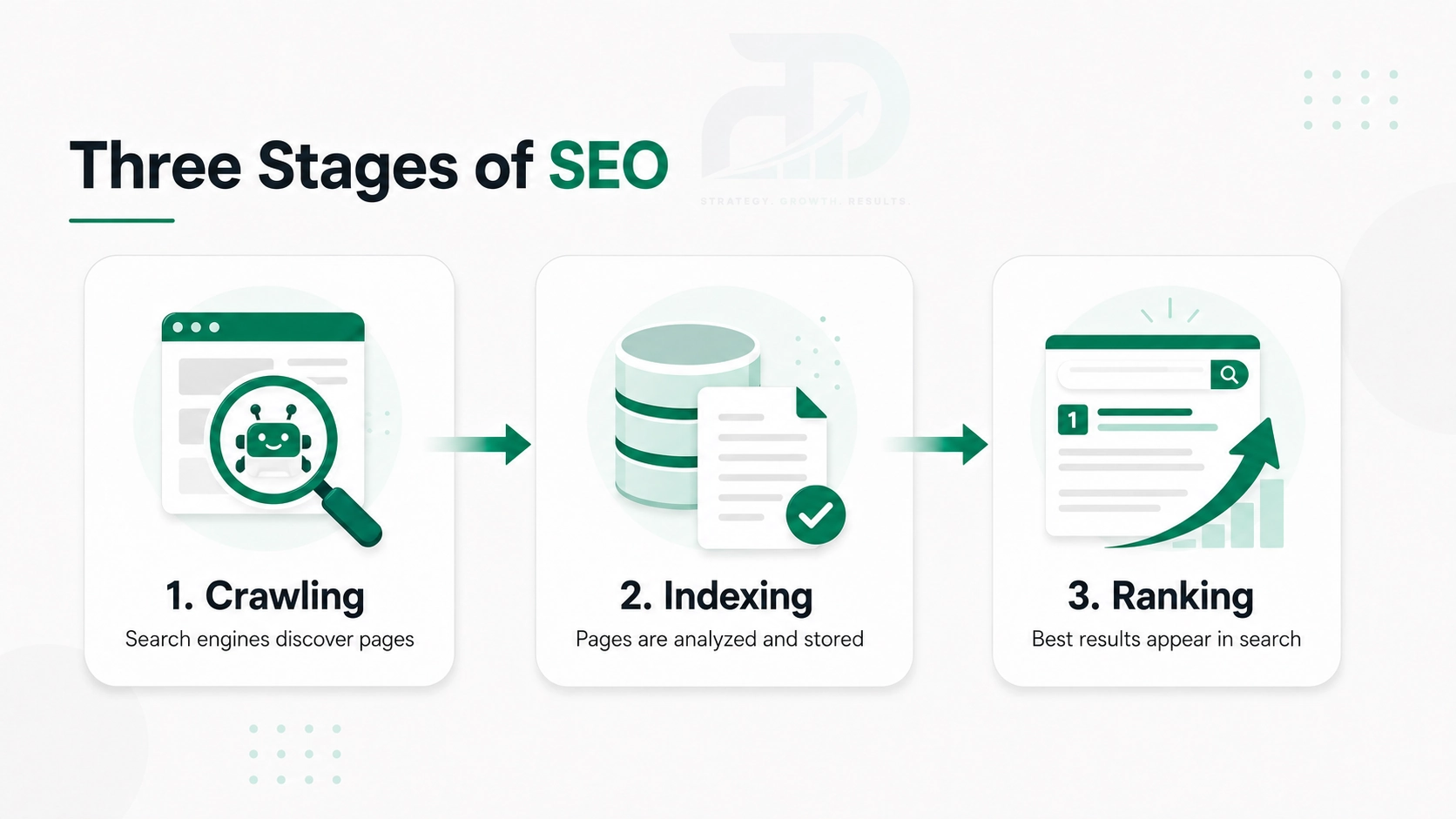
SEO works in three stages: crawling, indexing, and ranking.
- Crawling — Google sends automated bots ("crawlers") across the web that follow links from page to page, discovering new and updated content.
- Indexing — once a page is crawled, Google analyzes and stores it in a massive database called the index — essentially a library of every page Google knows about.
- Ranking — when someone searches, Google's algorithm scans that index and ranks pages based on hundreds of factors: keyword relevance, page speed, mobile-friendliness, backlink quality, content depth, and how well the page actually satisfies the search intent behind the query.
This is also why SEO takes time. A page has to be found, understood, and then proven — over weeks of user behavior and comparison against competitors — before Google trusts it enough to rank it well.
Where SEO Fits in Digital Marketing
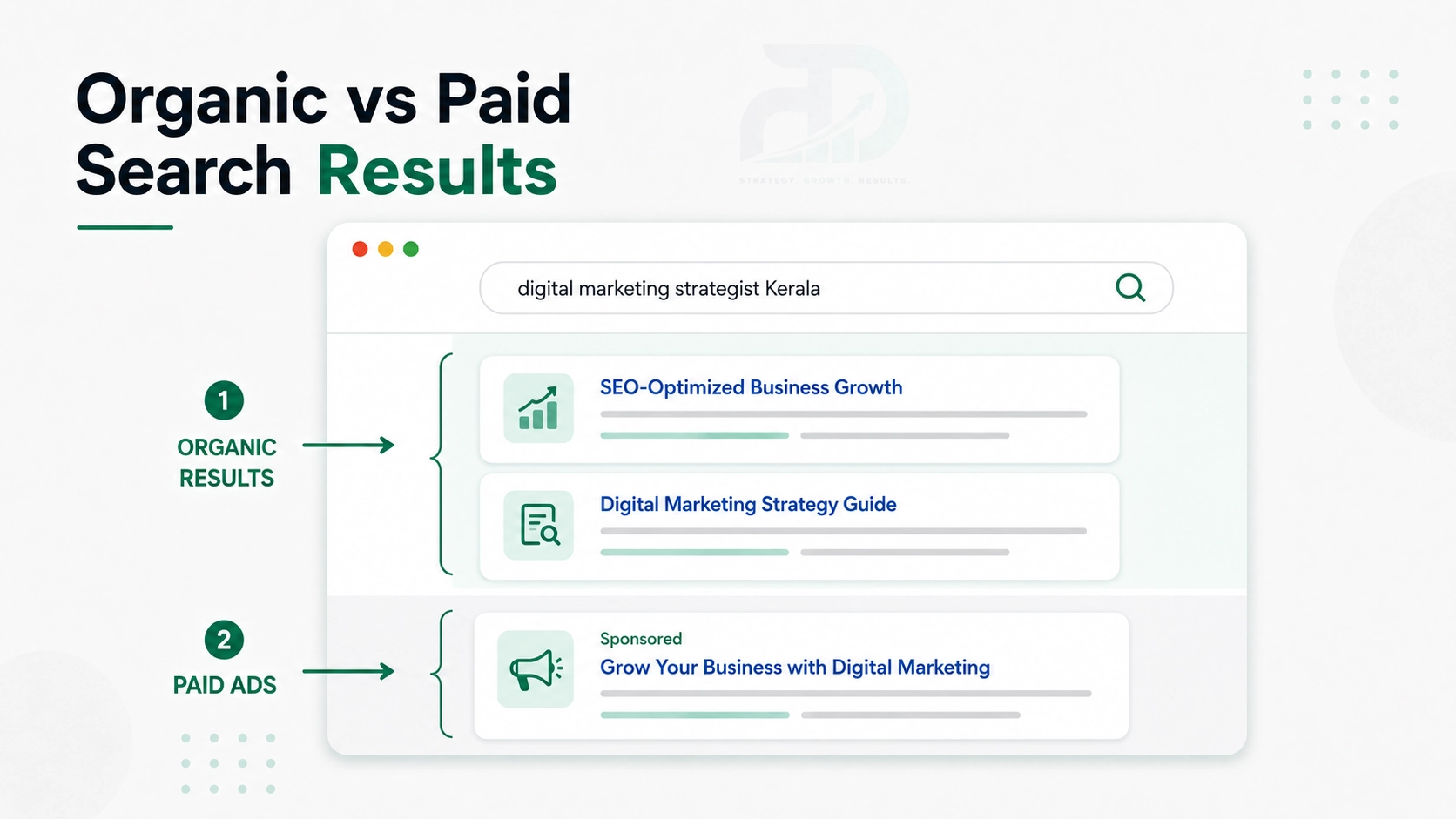
SEO is one channel inside a much bigger digital marketing picture — and it plays a different role than paid channels.
Unlike paid search (PPC/Google Ads), where visibility disappears the moment you stop paying, organic traffic from SEO is free to receive once you've earned the ranking, and it tends to compound over time. That's also why SEO is usually one of the highest long-term-ROI channels available to a business, even though it takes longer to kick in than paid ads.
In practice, SEO overlaps with several other parts of a marketing plan — content marketing, social media (SMO), and even sales, since better organic visibility directly feeds the top of a sales funnel.
If you're weighing SEO against other marketing channels, see our full breakdown of SEO pricing in India to understand what drives the cost.
The Types of SEO (Quick Overview)
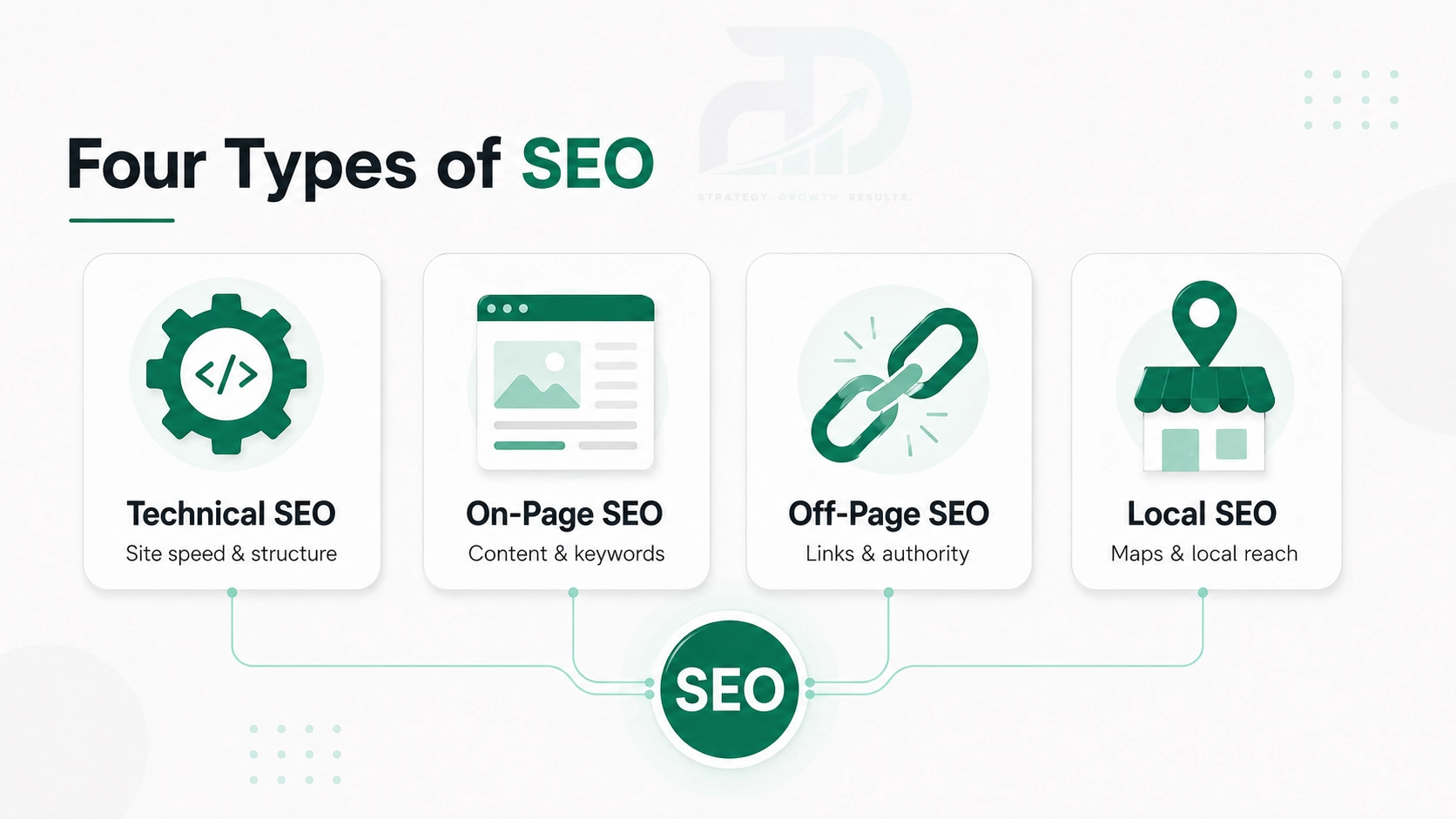
SEO breaks down into four core types. Each one gets its own full guide — this is just the map.
- Technical SEO — the behind-the-scenes work: site speed, crawlability, indexing, mobile-friendliness, and fixing errors that block Google from understanding your site.
- On-Page SEO — optimizing what's actually on the page: title tags that rank, headings, content quality, internal links, and image alt text.
- Off-Page SEO — building authority outside your own site, mainly through backlinks, guest posts, and outreach.
- Local SEO — ranking for location-based searches (like "SEO expert in Kerala") through Google Business Profile, citations, and local content — essential for any business serving a specific city or region.
Most businesses need all four working together, not just one.
Where You'll See SEO in Practice
SEO isn't limited to blog posts and web pages. The same principles apply anywhere content gets discovered through search:
- YouTube SEO — optimizing video titles, descriptions, and tags so videos surface in YouTube and Google search
- Writing SEO-friendly content — means answering a real question clearly, not repeating a keyword
- Web design and development — page structure, code quality, and load speed all directly affect how well a page can rank, regardless of how good the writing is
Is SEO Still Relevant in the AI Era?
Short answer: yes — but the game is changing, not disappearing.
With Google's AI Overviews and the rise of AI chatbots as a discovery tool, some people assume "SEO is dead." It isn't. What's changing is where answers get surfaced — AI-generated summaries now sit above traditional blue links for many searches. But those AI summaries are still built by pulling from well-optimized, trustworthy, well-structured web content. Sites with strong SEO fundamentals are the ones AI tools cite and pull from. Ignore SEO, and you don't just lose traditional rankings — you become invisible to AI search too.
SEO has evolved before (from keyword-stuffing in the early 2000s, through mobile-first indexing, to today's AI-driven search) and it will keep evolving. The businesses that stay visible are the ones that keep adapting to recent Google algorithm updates rather than betting on any one static tactic. Five years from now, SEO will look different — but "being the most relevant, trustworthy answer to a search" isn't going away.
Quick Answers (FAQ)
What is SEO optimization?
SEO optimization is the ongoing process of adjusting a website's content, technical setup, and authority so it ranks higher in organic (unpaid) search results.
What do you mean by SEO?
In simple terms, SEO means making a website that both search engines and real visitors find relevant, trustworthy, and easy to use — so it shows up when people search for what that business offers.
Is SEO a good career?
Yes — SEO roles like SEO analyst, SEO executive, and SEO specialist are in steady demand as more businesses shift budget from paid ads toward sustainable organic growth. Many people start with an SEO internship or entry-level executive role and move into strategy or agency ownership.
Is SEO still worth it in 2026?
Yes. Organic search remains one of the highest-ROI marketing channels available, and AI-powered search still relies on well-optimized content as its source material.
Ready to Stop Guessing and Get a Strategy Built for Your Business?
Talk to an SEO Expert in Kerala and find out what's actually holding your website back.

Written by Ajmal
Sharing practical tips on SEO, automation, and digital growth.